The Events Left in the 2026 Season
The BWF World Championships runs from 17 to 23 August 2026 at the Indira Gandhi Arena in New Delhi. It is the 30th edition of the event and the first time India has hosted it since 2009.
The World Tour picks up again nine days after the final:
- China Masters (Super 750), Shenzhen, 1 to 6 September
- Korea Open (Super 500), Yeosu, 8 to 13 September
- Vietnam Open (Super 100), Ho Chi Minh City, 8 to 13 September
- Denmark Open (Super 750), Odense, 13 to 18 October
- French Open (Super 750), Paris, 20 to 25 October
- Hong Kong Open (Super 500), 17 to 22 November
- BWF World Tour Finals, Hangzhou, 9 to 13 December
Between those sit the Arctic Open in Vantaa, the Hylo Open, the Japan Masters in Kumamoto, the Syed Modi International in Lucknow and the Guwahati Masters. Badminton at the Asian Games in Aichi-Nagoya also runs from 20 to 29 September.
The full 2026 World Tour is 29 tournaments plus the Finals, split into four Super 1000 events, six Super 750, nine Super 500 and ten Super 300. Ten Super 100 events sit outside the World Tour proper but still carry ranking points. Prize money broadly follows the tier:
- Super 1000: at least US$1,450,000
- Super 750: at least US$950,000
- Super 500: around US$500,000
- Super 300: around US$250,000
Individual events go above the floor. This season the China Open put up US$2,000,000 and the Singapore Open US$1,000,000. Hangzhou carries US$3,500,000, the final year of a four-year US$11.5m BWF commitment and the biggest purse in the sport.
Why the Worlds Price Differently to a Super 1000
The World Championships is not just a bigger tournament. It is built to a different set of rules, and those rules change what the draw looks like.
Each singles event has a 64-player draw. Each of the three doubles events has 48 pairs. Qualification was settled on the BWF World Rankings dated 28 April 2026, and it produced a field of 382 players, with China sending the largest contingent at 24.
The detail that matters most for pricing is the entry cap. A member association gets four entries in a discipline only if it holds ranks one to eight, three entries for ranks nine to 24, and two entries for ranks 25 to 150. At a Super 1000 there is no equivalent brake, so China or Japan can put a wall of players into one half of the draw. Here they cannot. The field is wider and flatter, which lengthens the outright favourite and shortens everyone in the next tier down.
Ranking points also work differently. The winner takes 14,500 points, the runner-up 12,500, a semi-finalist 10,500, a quarter-finalist 8,200, a last-16 finish 6,000, last 32 3,700 and last 64 1,450.
There is no third-place playoff. Both losing semi-finalists take a bronze, so each discipline awards two. That kills the third-place market you would find at a football tournament and makes to reach the final the sensible market for anyone backing an outsider deep into the draw.
India's home contingent is ten strong. Lakshya Sen and Ayush Shetty qualified in men's singles, PV Sindhu and Unnati Hooda in women's singles, and Satwiksairaj Rankireddy with Chirag Shetty plus Hariharan Amsakarunan with MR Arjun in men's doubles. A home Worlds is the busiest week betting on badminton in India will see all year. Withdrawals happen right up to the first day, so check the published draw before staking anything on a named player.
The Markets You Will Actually See
Badminton is not priced like tennis and it is not priced like football. Across the books that cover BWF events, the standard set looks like this:
- Match winner. Two outcomes only. There is no draw in badminton.
- Game handicap. Almost always -1.5 or +1.5. Explained in the next section, because it does not behave the way a football handicap does.
- Point handicap. One side gets a start in points. Books differ on whether the line runs across the whole match or applies to a single game, so read the market name before you stake.
- Total points. Offered on the match and on individual games. The two lines behave very differently.
- Correct score. Only 2-0 or 2-1 to either side. Four options, nothing else.
- Current game winner, current game correct score and current game total points. Live markets that reset when a game ends.
- Next point. The shortest live market in the sport, repriced every rally.
- Tournament outright, and at some books to reach the final or to reach the semi-finals.
How many of those you get depends on the tournament. Super 1000 and Super 750 events are usually priced in full. Super 300 and Super 100 events are often listed with match winner alone, and sometimes are not listed at all. Check the tier before you plan a bet around a market that may not exist.
A Game Handicap Is Not an Asian Handicap
A game handicap looks like a football handicap. The arithmetic underneath it is nothing alike.
A BWF match is best of three games. That means there are only four possible final scorelines: 2-0 or 2-1 to either player or pair. Nothing else can happen.
So a game handicap has almost no room to move:
- -1.5 on the favourite pays only if they win 2-0. A 2-1 win loses the bet.
- +1.5 on the underdog pays if they win a single game, whether or not they win the match.
That second line is worth sitting with. You can back a player at +1.5, watch them lose the match, and still collect, because they took one game. It is closer to a "will this be competitive" bet than a result bet.
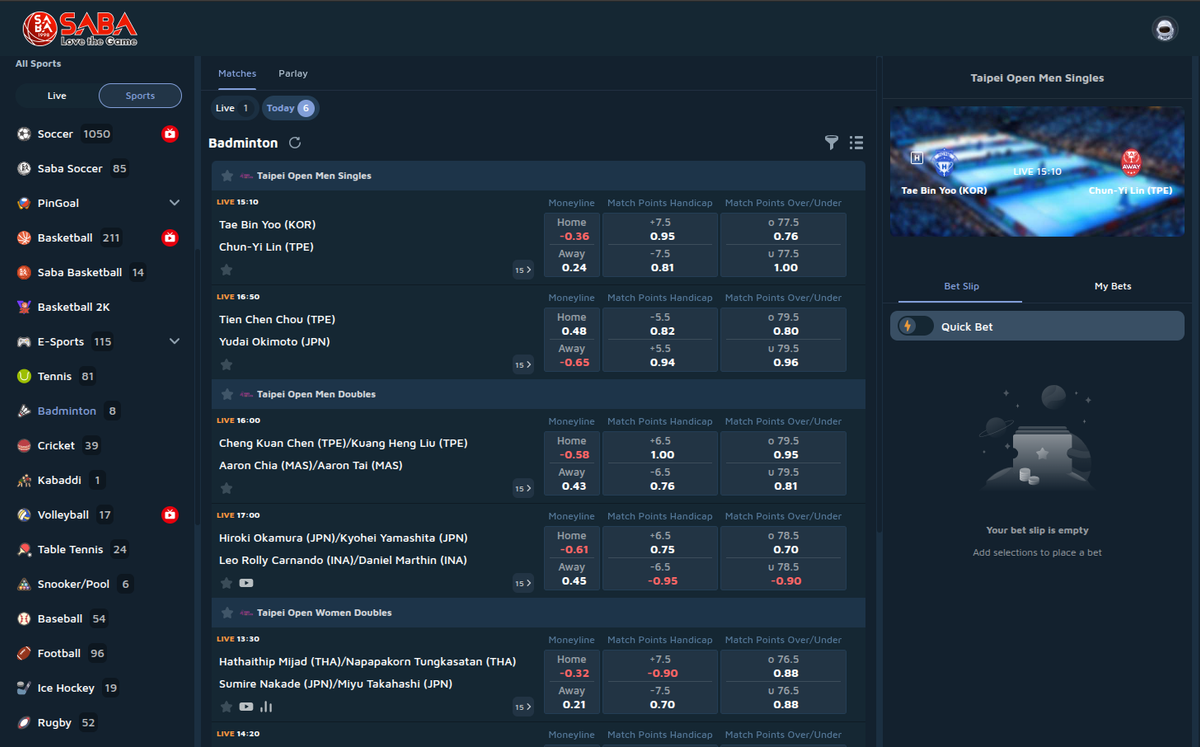
The pricing gap follows from the maths. A heavy favourite might be almost unbackable on the match winner market, and still be a genuine price at -1.5, because dropping one game to a decent opponent is common. That gap is where most of the value in badminton sits, and it is much wider than the equivalent gap in football.
The comparison to football is where people go wrong. In football, -1.5 sits on a scale with -0.5, -0.25, -1.0, -2.0 and everything between, and quarter lines split your stake in two. Badminton has none of that. There are no split stakes on a game handicap and no refund line, because a game cannot be drawn. If you are used to those mechanics, our Asian Handicap guide covers what football does that badminton does not.
Total Points and the 29-All Ceiling
Badminton uses rally point scoring. Every rally scores, regardless of who served. A game goes to 21 points, but a side must lead by two. At 20-all, play continues until someone leads by two. At 29-all, the side that wins the 30th point takes the game.
That cap gives every totals line a hard floor and a hard ceiling:
- A single game produces between 21 points (a 21-0 whitewash) and 59 points (a 30-29 marathon).
- A full match produces between 42 points and 177.
The Japan Open in July showed the top end. The women's doubles final went to 30-29 in the deciding game, the highest score the current rules allow.
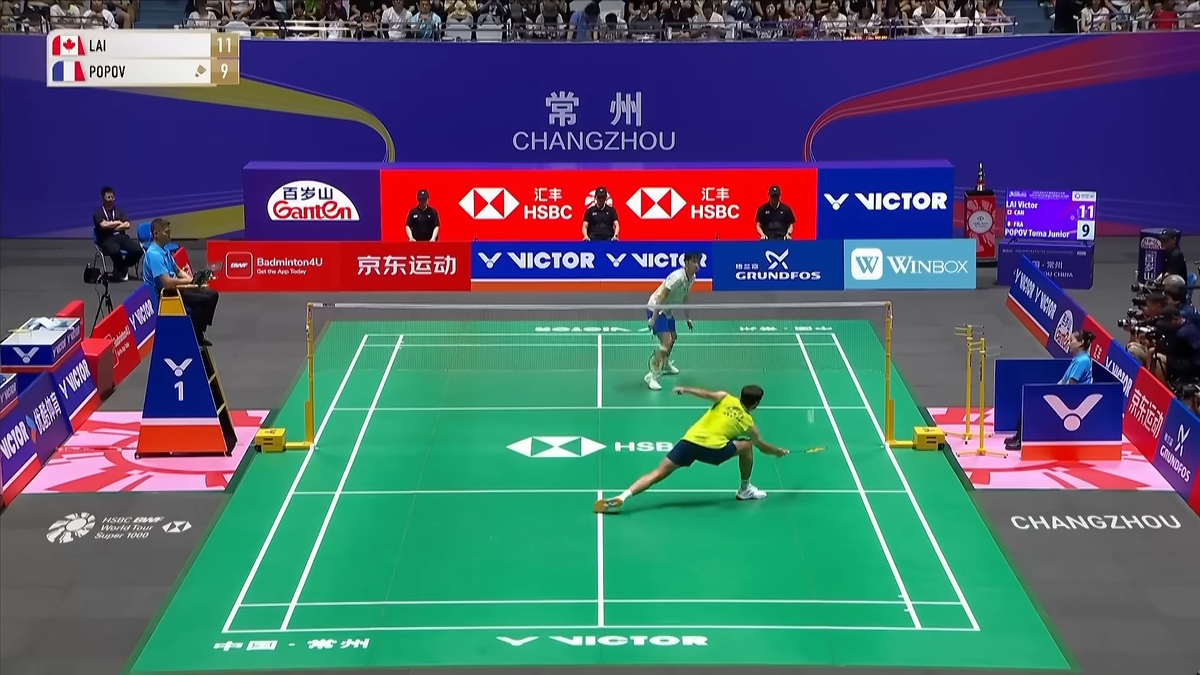
Match totals and game totals need to be read differently. A match total is really a bet on whether the match goes to three games, because a third game adds at least 21 points and usually closer to 40. Two evenly matched players will clear an over line simply by going the distance. A one-sided 2-0 result buries it. Game totals are the cleaner bet if you have a read on how close a specific game will be, and they are unaffected by whether the match runs long.
Games Go to 15 From 4 January 2027
Nothing in the section above survives next January.
BWF members approved a 3x15 scoring system at the 87th BWF Annual General Meeting in Horsens, Denmark on 25 April 2026, passing it by the required two-thirds majority. It takes effect on Monday 4 January 2027.
The whole of the 2026 season is played under the current 21-point rules, including New Delhi in August and the World Tour Finals in Hangzhou in December. The changeover lands after the season ends.
For anyone betting totals, this is a full reset. Under 3x15, a game produces between 15 and 41 points, and a match between 30 and 123. Every game total line drops by roughly a third, and every match total with it. The comfortable numbers you learn watching this season's markets will be wrong in January, and the books will be repricing a sport with no historical data under the new format for the first few months.
The other effect is on live betting. Fewer points per game means a deficit is harder to recover, and the window where a live price is worth taking gets shorter. Whether that pushes correct-score and game-handicap prices around is something the market will work out in real time.
Retirements Settle Differently From Book to Book
Badminton players retire mid-match more often than most bettors expect, and this is the single biggest gap between what people assume and what their bookmaker actually does.
The Malaysia Open final in January is the case to learn from. Kunlavut Vitidsarn was leading Shi Yuqi when Shi retired in the second game with a back injury. One match, one retirement, and a different result on your account depending on which sportsbook took the bet.
- SBOBET, which powers the sportsbook at several Asian-facing brands, voids bets on a match that starts but does not finish, unless that specific market was already decided. Their rules go further than most: a market that a natural finish would certainly have settled is still void. Their own worked example is a game abandoned at 20-17, where Over 37.5 total points is voided even though any real finish reaches at least 38.
- bet365 uses the same 20-17 example and reaches the opposite conclusion. It settles Over 37.5 as a winner, because the outcome could not have changed.
That is the whole problem in one line. Two books, the same scoreline, the same market, and one refunds you while the other pays you.
CMD368, Saba Sports and BTi Sports each publish their own rules, and the wording is not identical. Do not assume the platform behind your account works the way the last one did.
Team competitions add another wrinkle. Most books keep bets on the overall team result standing even when an individual rubber is given away by walkover. Check that separately before the next Thomas and Uber Cup cycle, because it is a different rule from the one covering a single match.
The Favourite Has Been Wrong All Year
The reflex bet in badminton is to back the Asian favourite. In men's singles, 2026 has punished it repeatedly.
Seven Super 750 and Super 1000 men's singles events have been played this season: the Malaysia Open, India Open, All England, Singapore Open, Indonesia Open, Japan Open and China Open. They produced six different winners, from four associations, and not one of them came from China, Indonesia, Denmark or Japan.
- Kunlavut Vitidsarn (Thailand) won the Malaysia Open in January.
- Lin Chun-yi (Chinese Taipei) won the India Open and then the All England, becoming the first Chinese Taipei men's singles champion in Birmingham.
- Alex Lanier (France) won the Singapore Open in May.
- Victor Lai (Canada) beat home favourite Jonatan Christie 21-19, 21-8 in Jakarta to become the first Canadian to win a Super 1000 title.
- Christo Popov (France) won the Japan Open in July.
- Chou Tien-chen (Chinese Taipei), aged 36, won the China Open by beating Toma Junior Popov 21-15, 7-21, 21-13, the oldest Super 1000 winner in the sport's history.
Shi Yuqi sat at world No. 1 on the ranking dated 28 July and is the reigning world champion. He has won the Badminton Asia Championships and Thomas Cup gold this year. He has not won a Super 750 or Super 1000 title. Lakshya Sen knocked him out in the first round of the All England, and a back injury ended his Malaysia Open final.
France are the pattern nobody priced in. They reached their first Thomas Cup final, losing 3-1 to China, and they hold the last two European men's singles titles through Lanier in 2025 and Christo Popov in 2026, who beat Anders Antonsen 21-12, 21-19 in April. Korea, meanwhile, took the Uber Cup 3-1 from China.
Women's singles has been the opposite story and is the steadier market. An Se-young won the Malaysia Open, the India Open, the Singapore Open and the Indonesia Open, where she beat Akane Yamaguchi 23-21, 21-12 for her third Indonesia Open title. Wang Zhiyi beat her in the All England final. Yamaguchi won the China Open, and PV Sindhu beat Yamaguchi at the Japan Open for her first Super 750 title. Four winners, all of them established names, none of them a shock.






Indonesian and Malaysian Players to Follow
Fajar Alfian and Muhammad Shohibul Fikri are the form pair in world badminton. They beat top seeds Kim Won-ho and Seo Seung-jae 21-19, 21-17 to win the Japan Open, then retained their China Open title against the same pair 16-21, 21-19, 21-19 a week later. A Super 750 and a Super 1000 inside a fortnight moved them to world No. 2. Note that this is a different partnership from the one still listed on plenty of older betting pages.
Indonesia's singles qualifiers are Jonatan Christie and Alwi Farhan in the men's draw, with Putri Kusuma Wardani and Thalita Ramadhani Wiryawan in the women's. Christie has a Super 1000 final on his record this season, losing the Indonesia Open at home. If you follow the domestic scene, our page on badminton betting in Indonesia covers the market there.
Malaysia's strongest card is in doubles. Goh Sze Fei and Nur Izzuddin won the Indonesia Open men's doubles. Chen Tang Jie and Toh Ee Wei defend the mixed doubles world title they won in Paris, Malaysia's first, and qualified fourth in the discipline. Pearly Tan and Thinaah Muralitharan were women's doubles runners-up at the 2025 Worlds. In singles, Malaysia qualified Leong Jun Hao and Justin Hoh in the men's draw, Letshanaa Karupathevan and Wong Ling Ching in the women's. The Malaysian badminton markets page has more on where those matches get priced.
The other titles on the line in New Delhi belong to Shi Yuqi in men's singles, Akane Yamaguchi in women's singles, Kim Won-ho and Seo Seung-jae in men's doubles, and Liu Shengshu and Tan Ning in women's doubles.
What to Check Before You Bet a BWF Event
Sportsbook coverage of badminton varies far more than it does for football. Five things are worth checking before you commit to a book for a tournament:
- Outright depth. Some books price the tournament winner and nothing else. To reach the final and to reach the semi-finals are the markets worth having in a 64-player draw, and not every book lists them.
- All five disciplines. Men's and women's singles are the two you can nearly always count on. Men's doubles, women's doubles and mixed doubles are where thinner books drop off, and doubles is where Indonesian and Malaysian bettors find most of their value.
- Market depth per match. Match winner alone is not enough for badminton. You want game handicap, point handicap and both totals lines to have anything to work with.
- Odds format. The same price shows differently in decimal, Hong Kong, Malay and Indonesian. Pick one in your account settings so you are not converting in your head between rallies.
- Live repricing. Badminton moves fast and a book that lags between rallies is not usable in play. Watch one match live before you stake in play.
The Integrity Rules Behind the Market
BWF prohibits any player who has competed in at least three international competitions from betting on badminton, and it contracts a betting-monitoring company that reports weekly on suspicious betting patterns at sanctioned events. The enforcement is real. Eight Indonesian players have been sanctioned for match-fixing and betting offences. Three were banned for life. The other five got bans of six to twelve years and fines of US$3,000 to US$12,000. An earlier case against two Malaysian players produced 20-year and 15-year bans with fines of US$25,000 and US$15,000.
For a starting point on operators, our list of badminton betting sites covers which books carry BWF events. Whichever one you pick, open its badminton rules page and read the retirement clause before the World Championships starts. That single page is worth more to you than any tip on the draw.

You Might Also Like
Frequently Asked Questions
When is the BWF World Championships 2026 and where is it being played?▾
What does a -1.5 handicap mean in badminton betting?▾
What happens to a badminton bet if a player retires mid-match?▾
When does badminton switch to the 15-point scoring system?▾
What is the highest possible score in a badminton game?▾
Who are the defending champions at the BWF World Championships?▾
Can you bet on Super 300 and Super 100 badminton tournaments?▾