The Tournament, and What It Is Called Now
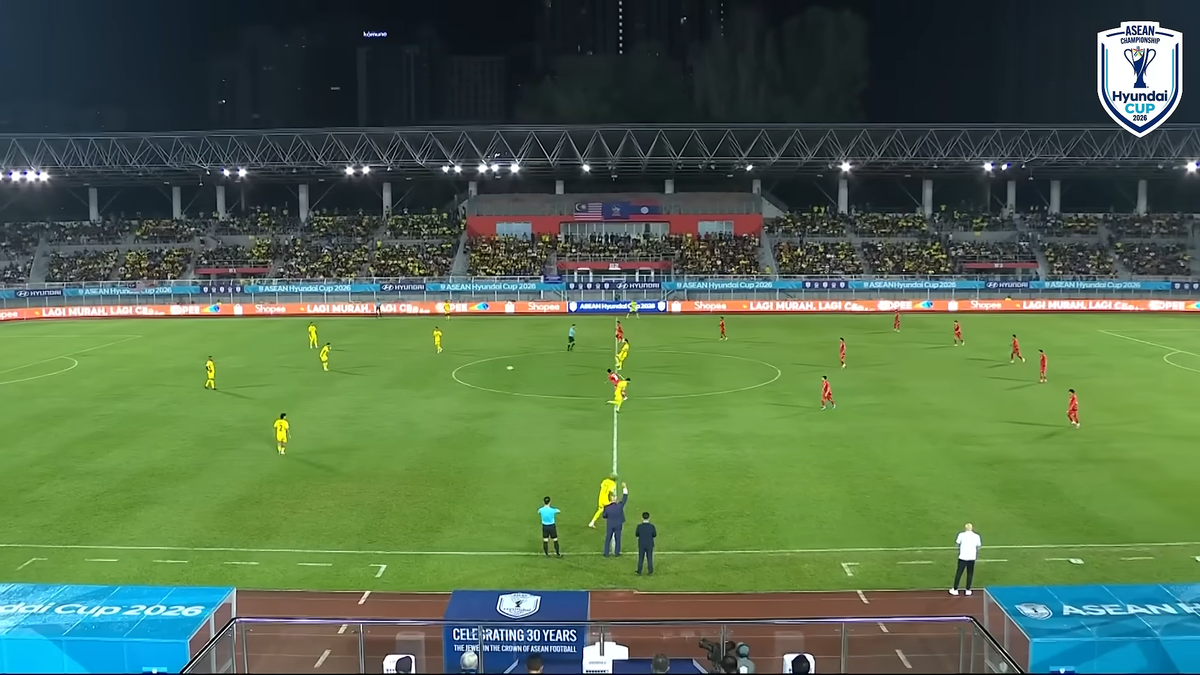
Southeast Asia’s biggest national team competition is underway. The group stage runs from 24 July to 8 August, the semi-finals follow on 15 to 19 August, and the final is decided over two legs on 22 and 26 August.
The name causes confusion, so here it is plainly. The competition is the ASEAN Championship. For 2026 it carries a new title sponsor and is officially the ASEAN Hyundai Cup, replacing the Mitsubishi Electric branding used in 2022 and 2024. Plenty of people across the region still call it the AFF Cup, after the ASEAN Football Federation that runs it. All three names point at the same tournament.
Two things make this edition different:
- It is the first summer edition. Every previous tournament ran in the year-end monsoon window. That is why the 2024 champions are defending after only about 18 months.
- There is no host nation. Every match is played at a participating country’s own ground, home and away, across nine countries. This is not a tournament held in one place.
Vietnam arrive as defending champions after beating Thailand 5-3 on aggregate in the 2024 final. Thailand remain the most successful nation in the competition’s history.
How the Format Changes Your Bets
Ten teams are split into two groups of five. The format has three features that matter before you place anything.
- Four matches, not five. Each group is a single round robin, so every team plays four games, two at home and two away.
- Everyone gets a bye. With five teams across five matchdays, one side sits out each round. This is why the table can show teams on different numbers of games played, and why the standings can badly mislead you at a glance.
- Only two go through. The top two in each group reach the semi-finals. Four teams from ten. There is no best-third-place route and no third-place playoff.
The tiebreakers matter more here than in most tournaments. If teams finish level on points, the first thing checked is head-to-head results, not overall goal difference. A team that wins 7-0 against the weakest side in the group banks a big goal difference that only counts after three separate head-to-head criteria have been applied. Thrashing a minnow looks impressive and is worth less than it appears.
Where the Groups Stand
Group A: Vietnam, Indonesia, Singapore, Cambodia, Timor-Leste
Group B: Thailand, Malaysia, Philippines, Myanmar, Laos
As of 31 July, Indonesia, Singapore and Malaysia lead on six points from two games. Vietnam and Thailand have three points with a game in hand, and each won their opener by five goals or more. Timor-Leste have lost all three of theirs without scoring, and Cambodia and Laos have lost both.
The fixtures that will settle it:
- 31 July: Vietnam vs Singapore in Hanoi, the defending champions against a Singapore side on six points from two
- 1 August: Thailand vs Malaysia at Rajamangala, both unbeaten, effectively for top spot in Group B
- 3 August: Indonesia vs Vietnam in Bogor, likely decisive for Group A
- 7 August: Singapore vs Indonesia, a possible straight shootout for a semi-final place
- 8 August: Thailand vs Myanmar and Malaysia vs Philippines close out Group B
Two quirks worth knowing before you bet a venue. Timor-Leste play their home games in Thailand, at Chonburi, because their national stadium does not meet hosting requirements. They get no home advantage at all. And Singapore are playing at Jalan Besar, a 6,500-capacity ground rather than their national stadium, so their qualification decider will be a tight, loud, unusual setting.
Asian Handicap on Lopsided Matches
This is where the tournament differs most from European football, and where most guides are no help.
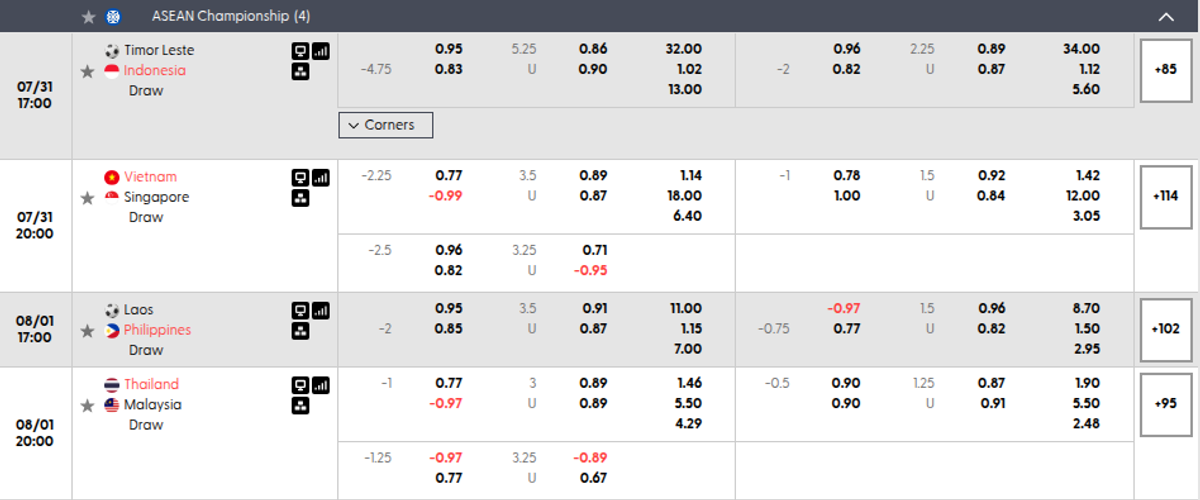
The gap between the strongest and weakest teams here is enormous. Vietnam and Indonesia are World Cup qualifying calibre. Timor-Leste and Laos have each conceded nine goals in two matches without scoring. That produces handicap lines you almost never see in club football. Expect -3.0 to -4.0 when a top side meets Timor-Leste or Laos, and roughly -1.5 to -2.5 against Cambodia or the Philippines.
The group stage so far has been brutally one-sided: Vietnam beat Timor-Leste 7-0, Thailand beat Laos 5-0, Indonesia beat Cambodia 5-1 and Malaysia beat Laos 4-0. Eight matches have produced eight winners and not a single draw.
How the big lines settle:
- Whole line (-3.0): win by four or more and you win. Win by exactly three and the stake is refunded. Win by two or fewer, draw or lose and the bet loses.
- Half line (-3.5): win by four or more, or lose. No refund is possible.
- Quarter line (-3.25): the stake splits across -3.0 and -3.5. Win by four or more and both halves win. Win by exactly three and half is refunded while half loses.
If the mechanics of split stakes are new to you, our Asian Handicap guide works through each line type.
Two-Legged Knockouts and the 90-Minute Rule
The semi-finals and the final are both played over two legs, home and away, with the aggregate score deciding who goes through. The away goals rule does not apply. If the aggregate is level after 90 minutes of the second leg, the tie goes to 30 minutes of extra time and then a penalty shootout.
That structure creates the single most expensive misunderstanding in knockout betting.
It works the same way it does in World Cup knockouts, which we covered in the World Cup knockout guide. The difference here is that the tie runs across two matches, so there is more to think about:
- First legs are straight 90-minute matches. No extra time is possible, so handicap and match result behave normally.
- Second legs can run past 90 minutes. Only the to-qualify market follows the tie that far.
- Aggregate handicaps are offered on the tie as a whole at some books. Check whether the line applies to the aggregate or just to one leg before staking.
The semi-final pairings cross over: the Group A runner-up meets the Group B winner, and the Group B runner-up meets the Group A winner. Group winners get the decisive second leg at home, which is a real reason to care about topping the group rather than just qualifying.
The Teams Worth Backing
Vietnam are the favourites and the defending champions, on a long unbeaten run under Kim Sang-sik and playing their group games in Hanoi. Their opening 7-0 was a statement. Their record in finals is strong, and both of their defeats came by narrow aggregates.
Indonesia are the most improved side in the region and arguably the value pick. Their squad is built heavily on naturalised players of Indonesian heritage, and the important detail for this tournament is that most of them now play in Liga 1 and other Asian leagues rather than Europe. Because this competition falls outside the FIFA international window, clubs are not obliged to release players. Indonesia are at close to full strength where they previously would not have been. A 19-year-old debutant scored a hat-trick in their 5-1 win over Cambodia.
Thailand carry the strongest history in the competition with seven titles, and beat Laos 5-0 in their opener. They meet Malaysia on 1 August in the biggest group fixture of the tournament. You can follow the domestic scene through our Thailand football coverage.
Malaysia have won both their matches and sit top of Group B, which is more impressive than it looks. They are without seven naturalised players who were suspended following a FIFA eligibility case upheld by the Court of Arbitration for Sport in March 2026, and the suspensions run through this tournament. Their current form is with those absences already priced in.
Singapore are four-time champions with an unusual record: they have reached four finals and won all four. They top Group A on points, though their two wins were narrow.
Myanmar bounced back from defeat to Malaysia by beating the Philippines 4-1 and remain live for a semi-final place. For a longshot, the to-reach-the-final market is a better home for your money than the outright, because a two-legged final punishes underdogs.






Outright and Group Markets
Tournament winner settles on the two-legged final. That structure matters: 180 minutes gives the better team more chance to prove it, so variance is lower than a one-off final. This helps favourites and hurts longshots. If you fancy an outsider, to reach the final is usually the smarter bet, because their real chance lies in getting there rather than surviving two legs against the best side left.
Group winner is worth a look right now precisely because the tables are misleading. Markets anchor to the standings, but Vietnam and Thailand both have games in hand, and the head-to-head tiebreaker means goal difference counts for less than the table suggests. Group winners also host the decisive second leg of their semi-final.
To qualify from the group is the steadier market for the stronger sides, since only two go through from each group and the top teams have a real cushion over the bottom three.
Totals have been the story of the group stage. With mismatches producing four and five-goal wins, overs have landed comfortably in the big-versus-small games. Expect the lines to reflect that now, and expect tighter, lower-scoring football once the knockouts start and both sides have something to protect.
Outright prices move constantly during a live tournament, so treat any number you see as a snapshot rather than a settled price.
Where to Bet in Southeast Asia
The ASEAN Championship is covered by most Asian sportsbooks, but coverage varies more than it does for European football. A few things to check:
- Handicap depth on the smaller ties. Every book prices Vietnam and Thailand. Not all of them offer full quarter lines on Laos or Timor-Leste matches.
- Two-legged markets. Confirm the book lists to-qualify and winner-of-tie for the semi-finals, not just match result on each leg.
- Live betting. Matches are spread across time zones from Vietnam to the Philippines. Check the book reprices in play if you plan to bet during games.
- Odds format. Prices show in decimal, Hong Kong or Malay format depending on the platform. Convert to one format before comparing books, because the same price looks very different across the three.
Most major Asian books carry the full set of football betting markets across the tournament, including outrights and group markets that stay open until the semi-finals begin.

You Might Also Like
Frequently Asked Questions
What is the ASEAN Championship 2026 and is it the same as the AFF Cup?▾
When are the ASEAN Championship 2026 semi-finals and final?▾
Are the ASEAN Championship semi-finals and final played over two legs?▾
Does Asian Handicap include extra time in the two-legged final?▾
Which teams have qualified from each group?▾
Who are the favourites to win the ASEAN Championship 2026?▾
Why are the Asian Handicap lines so big in this tournament?▾